Dating in 2026: What It Means and What Actually Works
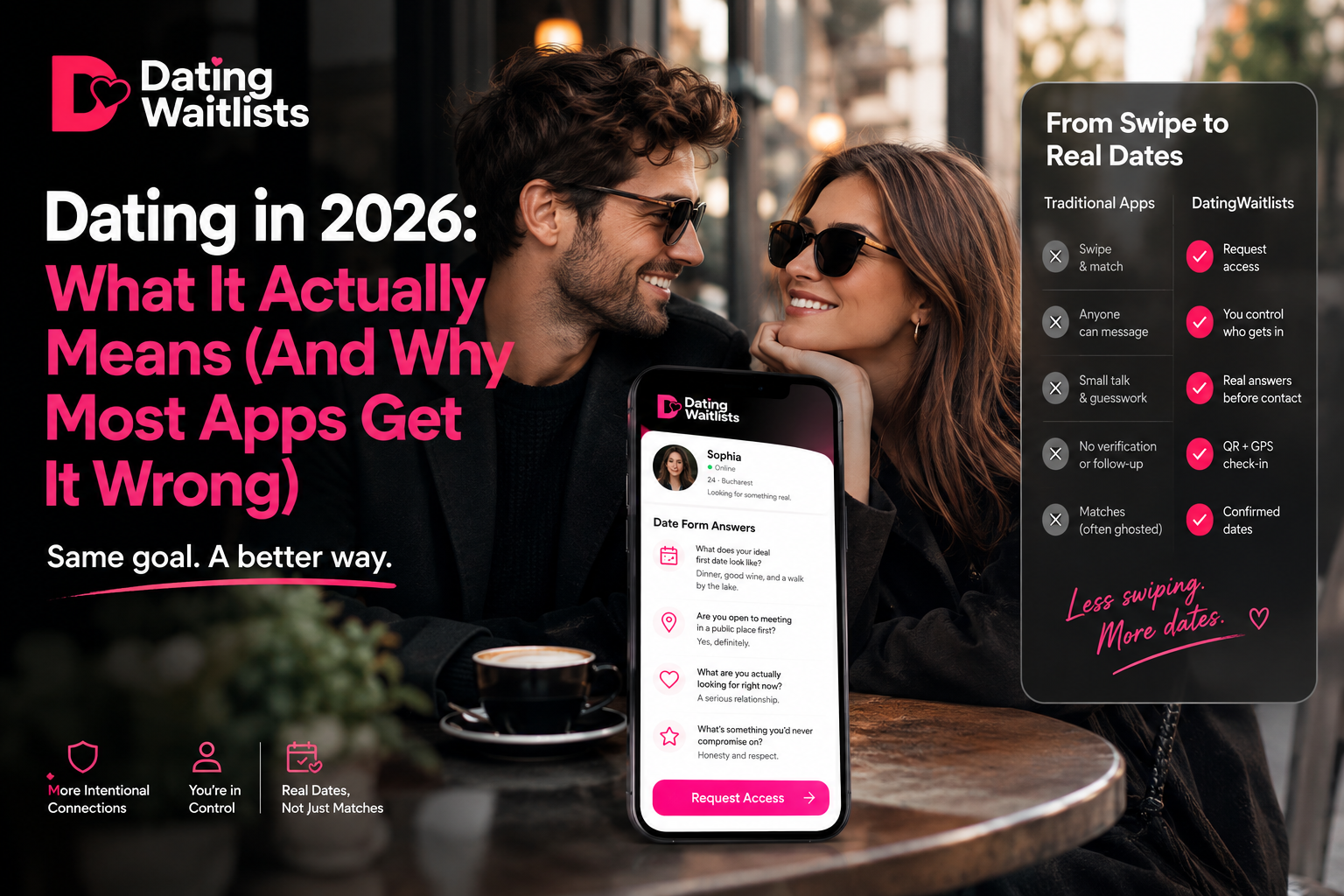
Dating is the process of meeting, evaluating, and spending time with potential romantic partners with the goal of finding a relationship, companionship, or a meaningful connection. It can happen in person, through mutual introductions, or through digital platforms — dating apps, social media, or profile-based systems like dating waitlists.
Modern dating has three stages that stayed constant for decades, even as the tools around them changed:
- Discovery — finding someone you're interested in.
- Qualification — figuring out if there's mutual interest and compatibility.
- Commitment to meet — turning interest into an actual, real-world date.
What changed in the last fifteen years isn't the goal. It's how much friction exists between step one and step three.
The short history of dating, in three eras
Era 1 — In-person and introduced. For most of history, dating happened through social circles: friends, family, work, school, religious communities. The pool was small, but the filtering was already done — someone you met through a friend came with implicit trust.
Era 2 — Swipe-based apps (2012–present). Swipe apps removed the friction of introductions but replaced it with a different problem: infinite choice. Discovery became instant. Qualification became superficial — a photo and a few lines of text. The result is what researchers and users alike now call dating fatigue: high volume of matches, low volume of actual dates.
Era 3 — Intent-based dating (emerging now). A newer category of platforms is optimizing for the step apps ignored: qualification. Instead of maximizing matches, these platforms — including waitlist-based and form-based profiles — ask people to declare intent up front, filter for those who show effort, and confirm that dates actually happen. DatingWaitlists is part of this category.
Why "more matches" stopped being the goal
The core metric dating apps optimized for — swipes and matches — turned out to be a bad proxy for the thing people actually want, which is a good date that happens. A match is not a date. A conversation is not a date. Most matches on swipe apps never convert into a real meeting.
This is the gap that intent-based dating platforms are built to close:
| Traditional swipe apps | Intent-based platforms |
|---|---|
| Optimize for matches | Optimize for confirmed dates |
| Discovery is instant, low-effort | Discovery requires a small amount of effort (a form, a request) |
| No verification that a date happened | QR + GPS check-in confirms the date in person |
| Reputation is invisible | Reputation reflects dates honored vs. cancelled |
| Anyone can message anyone | The profile owner controls who gets in |
What a "dating waitlist" is
A dating waitlist flips the standard app model. Instead of an app deciding who you see, a person publishes their own profile with real availability, and other people request access to that specific person — the same way you'd request an invite to something exclusive, instead of scrolling an endless feed.
The person approves who gets in, negotiates the date in a persistent chat, and — on platforms like DatingWaitlists — confirms the date actually happened through a QR code and GPS check-in at the venue. This closes a loop that swipe apps never built: proof that a date, not just a match, took place.
What makes dating "intentional"
Intentional dating means every step filters for effort and seriousness instead of just availability. In practice, that looks like:
- A form or question set before contact. Answering a real question about what you're looking for is a higher signal of interest than a copy-pasted opener.
- Visible, real availability. Instead of guessing whether someone is free, availability is stated up front.
- A negotiation, not a ghosting risk. A persistent thread where proposals and counter-proposals are logged keeps both sides accountable.
- A confirmed outcome. A check-in at the venue means a date is a real, verifiable event — not just a plan that quietly fell through.
FAQ
Is online dating still effective in 2026?
Yes, but effectiveness has shifted from apps that maximize matches to platforms that maximize completed dates. Volume-based swiping still produces matches; it produces far fewer actual, confirmed dates. Intent-based and waitlist-based platforms are gaining ground specifically because they measure and optimize for the date itself, not the match.
What is dating fatigue?
Dating fatigue is the exhaustion that comes from repeating the same low-effort interactions — matching, small talk, and drop-off — across many people, with a low rate of actual dates resulting. It's driven by high volume and low filtering, which swipe-based apps are structurally built around.
What's the difference between a dating app and a dating waitlist?
A dating app shows you many profiles and lets anyone message anyone who matches. A dating waitlist is built around one person's profile at a time: that person sets their availability and terms, and others request access to them — shifting control to the profile owner and filtering for people willing to make a real request rather than a passive swipe.
Do verification and safety features actually reduce dating risk?
Verification badges, identity checks, and check-in systems don't eliminate risk, but they materially reduce it by confirming who someone is before a date and confirming a date happened afterward — creating accountability that anonymous swipe-and-message systems don't have.
What should I look for in a modern dating platform?
Three things matter most: whether the platform filters for intent (not just appearance), whether it gives you control over who reaches you, and whether it has any mechanism to confirm dates actually happen rather than just tracking messages sent.
The bottom line
Dating didn't change — the process of finding someone and meeting them is the same as it's always been. What changed is the tooling, and for the last decade that tooling optimized for the wrong metric: matches instead of dates. Platforms built around intent, real availability, and confirmed outcomes — like DatingWaitlists — are the next correction in that history: not a new trend, but a return to what dating was always supposed to filter for, people who actually show up.
---
Ready for fewer matches and more real dates? Create your dating waitlist and let the right people request access.