Dating Waitlist: The Trend Set to Define Dating Next Year
Dating culture moves in cycles: a model dominates, people get exhausted by its worst side effects, and the next model rises specifically to fix what the last one broke. Location-based swiping reduced the friction of old-school online dating profiles. Video-first formats tried to reduce catfishing. Now the exhaustion has shifted again—toward the sheer volume of swiping itself—and the next correction is forming around a much older idea: the dating waitlist.
What a dating waitlist actually is
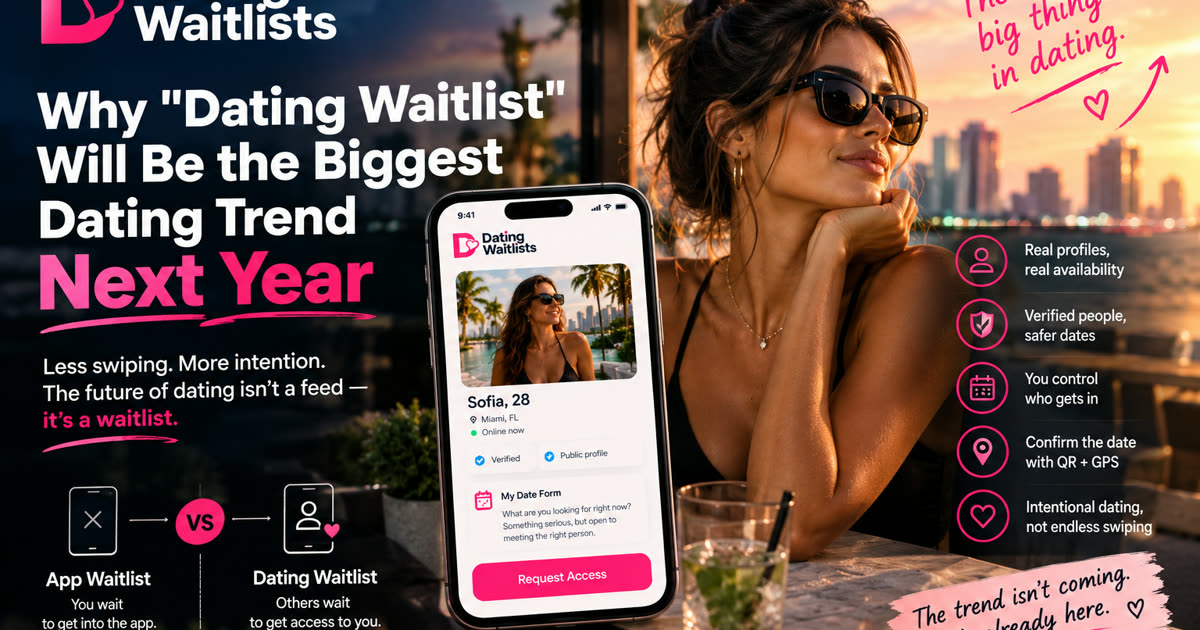
A dating waitlist is a personal profile a single person shares—with real availability, verified badges, and a personal access code—where other people join their waitlist to request an actual date. The profile owner approves who gets in, negotiates the date directly, and on platforms like DatingWaitlists, confirms it happened through a QR + GPS check-in.
It is the opposite of a swipe feed. Instead of an algorithm showing you hundreds of strangers, one person's real availability is the whole interaction—and getting access to it takes actual effort, not a flick of a thumb. For a deeper definition, read what a dating waitlist is and how it works.
Why this model is positioned to grow next
1. Swipe fatigue is shaping what people want next
The exhaustion of matching with dozens of people and having almost none of it convert into an actual date is a recurring frustration across dating conversations, forums, and app reviews. A model that filters for intent before contact addresses the problem directly: not more messaging, but less of it, aimed better.
2. “Verified” and “intentional” are becoming core expectations
Major dating platforms have added identity verification, video prompts, and intentions fields—all attempts to add more honesty to a system built for volume. A dating waitlist does not treat these as extras. Availability, verification, and intent are the structure of the profile.
3. Younger daters already behave this way manually
People already share availability signals, tell selected followers who can message them, and state “shoot your shot” conditions in social bios. A dedicated dating waitlist formalizes that behavior with a profile, access rules, and a clear next step.
4. Accountability closes the gap between matching and meeting
Mainstream dating products measure matches and messages, but those signals stop short of the outcome that matters: whether two people actually met. A model built around confirming the date itself—not just the conversation leading to it—adds accountability where swipe-based systems usually end.
5. A personal profile is naturally shareable
The model spreads through the same behavior it enables. Someone shares their profile link or handle in a bio, a group chat, or directly with a person they like. The first interaction does not depend on endlessly browsing a feed.
What this could look like over the next 12 months
If dating waitlists follow the adoption pattern of other dating shifts—from niche behavior to early adoption and then wider normalization—the next year could develop in four stages:
- Early adopters move first. People already tired of dating apps begin replacing app-first bios with a shareable waitlist profile.
- Social proof compounds. As more people see a friend's or creator's waitlist link, the format becomes recognizable rather than novel.
- Existing products respond. Swipe-based platforms may add more availability or request-access tools in response to the same behavior.
- Verification and accountability become expected. Identity signals and confirmed outcomes move from optional extras toward baseline expectations.
Why this is more than another dating feature
Most dating trends are features: a new prompt type, a new matching algorithm, or a new safety badge. A dating waitlist changes who holds control in the interaction. On a swipe app, the platform decides who appears. On a dating waitlist, the person decides who reaches them.
That shift—from platform-controlled discovery to person-controlled access—is the real change. It is also why the model is harder to copy with a single feature update.
DatingWaitlists supports that structure with dating forms, real availability, identity checks, private access options, and QR + GPS date confirmation.
FAQ
What does “dating waitlist” mean?
A dating waitlist is a personal profile where one person shares their real availability and other people join a list to request access to that person specifically. It is not a waitlist to join a dating app.
Why could the dating waitlist trend grow now?
It responds to two common frustrations with swipe-based dating: overwhelming choice that rarely becomes a real date, and limited accountability after a match. The waitlist model puts verification, intent, availability, and person-controlled access at the center.
Is a dating waitlist the same as a regular dating app?
No. A dating app usually shows a feed of profiles to browse. A dating waitlist centers one person's profile and availability, with other people requesting access to that specific person rather than scrolling through an endless feed.
Will dating apps copy the waitlist model?
They may adopt individual parts of it, such as availability or request-access tools. The larger difference is structural: a dating waitlist starts with one person controlling access to their own profile rather than an algorithm controlling a feed.
Get ahead of the trend
Set up your own waitlist while the model is still early: one profile with real availability, verified identity, and a clear path from interest to an actual date.